The Role of Provincial Rules in Advancing App-Based Table Games in Eastern Canada
Written by Tina Müller · Aug 24, 2026

The Role of Provincial Rules in Advancing App-Based Table Games in Eastern Canada
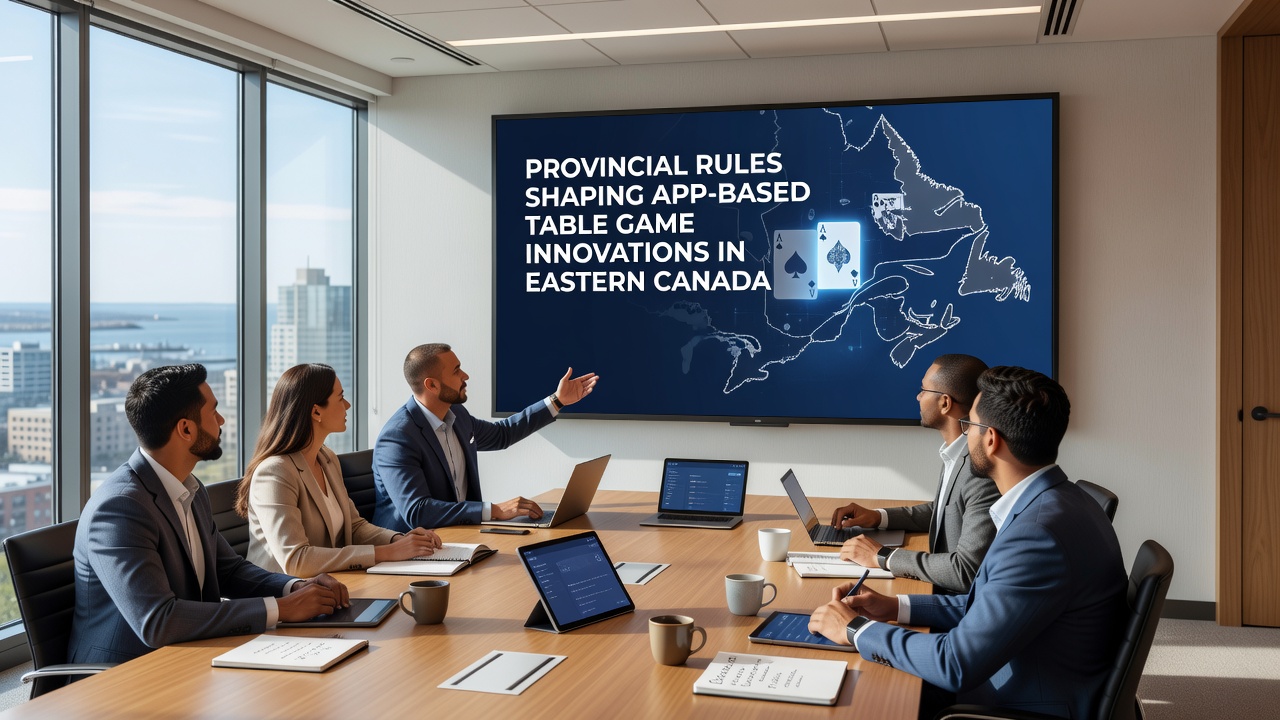
Provincial regulations across Eastern Canada continue to guide the evolution of app-based table games, with rules on licensing, random number generation, and player verification shaping product design in provinces such as Nova Scotia, New Brunswick, Newfoundland and Labrador, and Prince Edward Island. These frameworks require operators to meet specific technical standards before launching mobile versions of blackjack, roulette, or poker, which in turn influences how developers integrate features like live dealer streams or multi-player tables.
Data from provincial gaming authorities show that compliance with location-based restrictions and age verification protocols often determines the pace at which new app features reach users. In August 2026, several updates to Nova Scotia's technical standards took effect, requiring enhanced encryption for real-money table game sessions and clearer disclosure of house edge percentages within app interfaces. Developers responded by adjusting server architectures to align with these requirements while maintaining smooth gameplay across devices.
Regulatory Variations Among Eastern Provinces
Each province maintains distinct oversight bodies that set parameters for app-based table games. Nova Scotia's gaming corporation enforces strict controls on virtual table game outcomes, mandating third-party audits of random number generators at regular intervals. New Brunswick follows a similar path through its alcohol and gaming authority, yet places additional emphasis on responsible gaming tools that must appear prominently in mobile applications. Newfoundland and Labrador and Prince Edward Island apply comparable rules, though their smaller markets often lead operators to adapt shared platforms rather than create province-specific versions.
Observers note that these differences create a patchwork environment where a single app may offer varying table game options depending on the user's detected location. Research from industry reports indicates that such variations encourage modular coding practices, allowing companies to toggle features on or off without rebuilding entire applications from scratch.
Impact on Innovation in Mobile Table Game Features
Provincial rules directly affect which innovations reach Eastern Canadian users. Requirements for geofencing and real-time identity checks, for instance, have prompted developers to embed advanced location services and biometric login options into table game apps. These additions help operators satisfy regulatory demands while also improving security for players engaged in extended sessions of games such as baccarat or three-card poker.
Studies conducted by the Canadian Gaming Association highlight how rules on advertising and bonus structures limit certain promotional mechanics within apps, leading teams to focus instead on gameplay enhancements like customizable table limits or statistical tracking dashboards. One developer group adjusted its roulette app to include province-approved session timers after New Brunswick updated its guidelines, demonstrating how regulatory feedback loops shape product roadmaps.
Figures from 2025 operator filings reveal that apps incorporating these adjustments experienced steadier user retention rates compared with those that required more frequent post-launch modifications. The pattern suggests that early alignment with provincial expectations reduces the need for disruptive updates later.
Collaboration Between Regulators and Technology Providers
Provincial authorities in Eastern Canada have established consultation processes with software vendors and operators. These discussions cover topics ranging from server location requirements to standards for live dealer video feeds. According to data shared by the Canadian Gaming Association, such meetings have accelerated the approval timeline for certain table game variants that meet predefined security benchmarks.
Technical working groups formed in 2025 examined how emerging technologies, including cloud-based rendering for mobile table games, could fit within existing rules. Participants reviewed case examples from other jurisdictions, including licensing models used in parts of Australia, to identify adaptable elements. The resulting recommendations have informed updates to application programming interface guidelines used by several Eastern provinces.
Data Trends and Market Responses
Market analyses indicate that app-based table game revenue in the region grew steadily through mid-2026, with provincial compliance serving as a key factor in sustained expansion. Operators that invested in localized testing environments reported fewer compliance-related delays when rolling out new poker or blackjack variants. Research indicates that provinces with clearer documentation of technical standards tended to attract more development activity from established providers.
One notable case involved a platform that introduced multi-hand blackjack features after securing simultaneous approvals in Nova Scotia and New Brunswick. The coordinated rollout allowed the operator to leverage a single backend system across both jurisdictions, reducing maintenance overhead while satisfying each province's distinct reporting obligations.
Conclusion
Provincial rules in Eastern Canada continue to define the boundaries within which app-based table game innovations develop. By setting requirements for security, verification, and feature transparency, these regulations shape both the technical architecture and the user experience of mobile table games. Ongoing collaboration between regulators and industry participants supports incremental advancements that align with provincial priorities, while data from recent filings demonstrate measurable effects on adoption and retention patterns. As frameworks evolve, developers maintain focus on modular designs that accommodate regional differences without compromising core functionality.